
Mibbi Blog
Small guides for messy brains.
Guides for Mibbi Tasks
Break big tasks into tiny steps.
-
How to Break Big Tasks Into Small Steps
A practical method to break a task that feels too big into small, doable steps — without writing a 40-line plan first.
-
How to Make Your To-Do List Less Overwhelming
Five small changes that turn a panic-inducing to-do list into one you actually open every day — cap it, split it, rewrite it, estimate it, and review it.
-
How to Break Down a Work Project Into Doable Steps
A practical method for turning a vague project brief into a working plan you can start today — without writing a thirty-page proposal first.
-
How to Plan a Cleaning Task Without Burning Out
Cleaning fails when "clean the house" stays as one task. Here is how to split it so you finish without resentment.
-
How to Split a Task When the First Step Already Feels Too Big
When the smallest step still feels heavy, the answer is to go smaller. A short guide to recursive task breakdown.
-
How to Handle a Task With No Deadline
No-deadline tasks linger forever because nothing ever forces the issue. Here is how to give them just enough urgency to actually get done.
-
How to Use Mibbi Tasks for Studying
A practical method for turning a textbook chapter, course module, or research paper into a finishable study plan.
-
How to Tell When a Task Needs Breaking Down
Not every task needs a plan. Here is the quick check that tells you when to break a task down — and when to just do it.
-
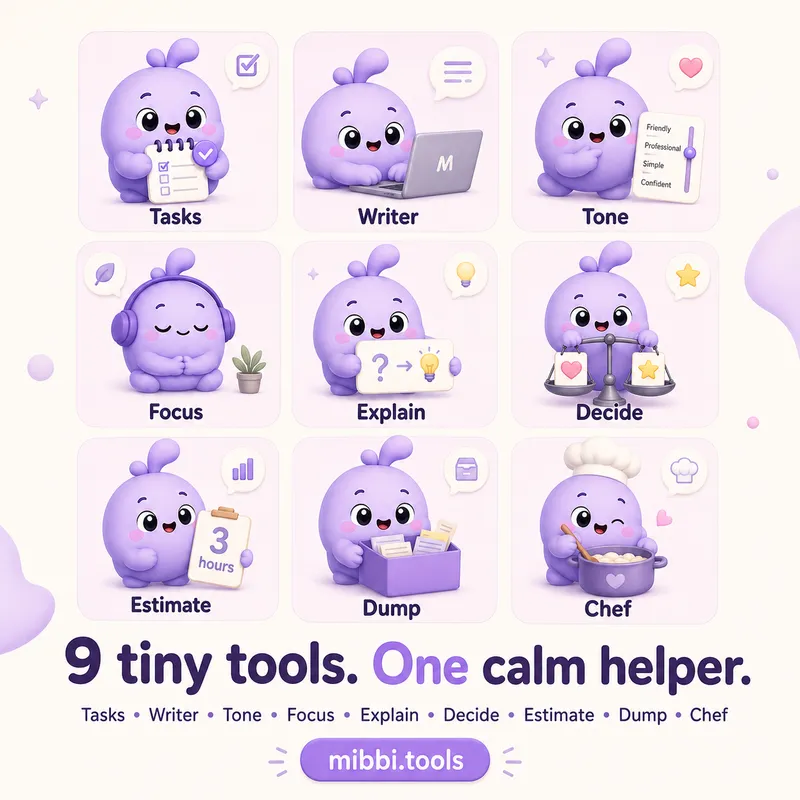
Best Goblin Tools Alternatives in 2026 (and Which One Wins for ADHD)
A practical, honest comparison of Goblin Tools alternatives in 2026 — what each does well, where they fall short, and which fits an ADHD brain best.
-
How to Break a Big Task Into Tiny Steps (When Your Brain Refuses To)
A step-by-step method for breaking an overwhelming task into pieces small enough to actually start — built for brains that stall on big, vague jobs.
-
Executive Dysfunction Explained — and the Tools That Actually Help You Start
Executive dysfunction is why you can know what to do and still not do it. Here is a plain-English explanation and the practical tools that help you start.
-
AI for ADHD: How Mibbi's Tiny Tools Help an ADHD Brain Get Things Done
A calm guide to using AI for ADHD without the overwhelm — how nine tiny tools map to the exact moments an ADHD brain gets stuck, from starting to finishing.
-
Goblin Tools vs ChatGPT for ADHD: Which One Actually Helps You Start?
Goblin Tools and ChatGPT can both break down a task, but they help an ADHD brain very differently. An honest comparison — and when to reach for each.
-
Are AI Productivity Tools Safe? What to Share and What to Keep Private
A plain-English guide to whether AI productivity tools are safe — what really happens to your text, what you should never paste in, and how Mibbi handles your data.
Guides for Mibbi Writer
Rewrite text so it sounds right.
-
How to Rewrite a Message Professionally
A simple checklist for turning a rushed or blunt draft into a message that sounds professional and warm — without losing what you actually meant to say.
-
How to Write a Polite But Direct Message
A four-part formula for messages that get to the point without sounding rude or cold — plus copy-ready examples you can adapt for email and chat.
-
How to Make Emails Sound More Professional
Five small changes that lift an email from informal to genuinely professional — a clear subject, a named greeting, an upfront ask — without sounding stiff.
-
How to Use AI Tools Without Losing Your Own Voice
AI can speed up writing, planning, and thinking — but it is easy to end up sounding like everyone else. Here is how to stay yourself.
-
How to Rewrite a Difficult Message Before Sending It
When the message you have to send is awkward, here is the method that lifts the tone without flattening the meaning.
-

How to Rewrite a Customer Service Reply So It Lands Better
Customer replies need warmth, accuracy, and brevity all at once. Here is a simple formula that hits all three without sounding scripted.
-
How to Shorten a Long Email Without Losing Meaning
Long emails get skimmed, not read. Here is a simple editing pass that keeps the substance, cuts the padding, and gets you a faster reply.
-
How to Write Feedback That is Easier to Receive
Feedback fails when the wrapper is harder to hear than the content. Here is how to rewrite feedback so it actually lands.
-
How to Make an Email Sound Professional Without Sounding Like a Robot
Make any email sound polished and professional while still sounding like a human. A simple method plus the words that quietly raise or lower your tone.
-
Formalizer vs. Plain Rewriting: How to Match Your Tone to Any Reader
Making text "more formal" is not always the right move. Here is how to match your tone to the actual reader — formal, friendly, firm, or plain.
-
How to Write Emails Faster With ADHD (Beating the Blank-Page Freeze)
Email is uniquely hard with ADHD — the blank box, the tone worry, the endless rewrites. A faster way to get from "I have to reply" to "sent" without the spiral.
Guides for Mibbi Tone
See how a message might sound.
-

How to Tell If a Message Sounds Rude
A short guide to checking the tone of a message before you send it — and reading received messages more generously.
-
How to Read a Confusing Message From a Coworker
When a coworker's message lands wrong and you cannot tell why, here is how to read it without assuming the worst.
-
How to Check Tone Before a Difficult Conversation
A short pre-conversation check that helps you spot the lines that might land wrong — and soften them before you are in the room.
-
How to Respond to a Passive-Aggressive Message
A short method for replying to messages that feel pointed — without escalating, and without pretending you did not notice the dig.
-
How to Tell If Your Message Sounds Anxious
The over-apologising, hedging, and over-explaining that make a message read as anxious — and how to catch them before you hit send.
-
How to Read Tone in Customer Emails (Without Overreacting)
Customer messages often read sharper than they were meant. Here is how to read tone fairly when the stakes are high.
-
How to Stop Misreading Text Messages
A short guide to catching the moment you fill in tone that was never there — and how to check your reading before you react.
-
How to Write a Softer Reply to an Angry Message
Replies to angry messages succeed when they lower the temperature without conceding the point. Here is the method.
-
Does My Message Sound Rude? How to Check the Tone Before You Hit Send
Worried a text or email comes across as rude or cold? Here is how to check the tone of a message before you send it — and fix it if it lands wrong.
Guides for Mibbi Focus
Pick one next step and stay focused.
-
How to Start When You Feel Overwhelmed
A short, kind playbook for when your to-do list is so long you freeze and cannot pick anything — how to unstick yourself and take one small action right now.
-
How to Choose One Task When Everything Feels Important
How to pick exactly one task when your whole list is screaming for attention — simple filters to break the tie and start moving without second-guessing.
-
How to Plan a Small Focus Session
A 25-minute focus session done well beats two hours of half-attention. Here is how to set one up — pick a clear goal, kill distractions, and protect the block.
-
How to Create a Simple Daily Plan
A 5-minute morning routine that produces a daily plan you will actually follow — three priorities, a rough order, and one thing to deliberately skip.
-
How to Get Unstuck on a Task You Have Been Avoiding
Stuck on a task for hours, days, or weeks? Here is a calm unstucking method that works by shrinking the task, not by summoning willpower.
-
How to Focus on Work When Your Energy is Low
Low-energy days are inevitable. Here is how to still get useful work done without forcing yourself into a worse state.
-
How to Stop Task-Switching All Day
Task switching feels productive but quietly costs you focus and time. Here is how to notice the habit and cut it down without forcing rigid focus.
-
How to Pick the Right Task for Your Current Mood
Matching tasks to mood instead of forcing yourself into the wrong one. A short guide to working with your day.
-
What Should I Do First? How to Pick One Next Step When Everything Feels Urgent
When every task feels equally urgent, choosing becomes impossible. Here is a calm, 4-step way to pick one next step and actually start.
-
ADHD Task Paralysis: Why You Freeze and a 5-Step Way to Get Unstuck
Task paralysis is not laziness — it is your brain stalling on a task it cannot start. Here is why it happens and a 5-step method to break the freeze.
-
Overwhelmed by Your To-Do List? A Calmer Way to Plan With ADHD
A long to-do list can paralyse instead of help. Here is a calmer, ADHD-friendly way to plan that turns an overwhelming list into a few doable next steps.
-
How to Start a Task With ADHD: The 2-Minute Momentum Trick
Starting is the hardest part with ADHD. The 2-minute momentum trick lowers the barrier so much that beginning becomes almost automatic. Here is how it works.
Guides for Mibbi Explain
Understand difficult things in simple words.
-
How to Explain Complex Ideas Simply
A short framework for explaining anything to anyone — with analogies, examples, and the right level of detail.
-
How to Explain Something to a Kid (Without Dumbing It Down)
Good kid explanations keep the truth and drop the jargon. Here is how to do both at once, with analogies that actually land for a young listener.
-
How to Explain a Legal Clause in Plain English
Contracts are written for lawyers, not people. Here is how to read a clause and put it into words you actually understand.
-
How to Understand Jargon Without Googling Forever
Jargon-heavy fields are easier than they look once you have a method. Here is how to decode unfamiliar terms fast, without a dozen tabs open.
-
How to Explain Something You Just Learned
Explaining what you just learned to someone else is the fastest way to lock it in. Here is how to do it without sounding shaky.
-
How to Study With Explainers Instead of Textbooks
Textbooks teach completeness; explainers teach intuition. Here is how to combine them without skipping the parts you need.
-
How to Explain Tech to a Non-Technical Friend
A short guide to explaining how a technology works — without words like "blockchain" or "infrastructure" — so a non-technical friend actually follows.
-
How to Verify an AI Explanation Before You Trust It
AI explainers are convenient but sometimes confidently wrong. Here is how to sanity-check one before you rely on what it told you.
-
Explain It Like I'm 5: How to Understand Any Complex Topic in Plain English
Stuck on a confusing topic, contract, or concept? Here is how the "explain like I am 5" approach helps you understand anything in plain English — fast.
Guides for Mibbi Decide
Compare options without overthinking.
-
How to Make a Decision With Pros and Cons
Pros and cons lists fail when they get long. Here is a tighter way to compare options that ends with a low-regret next step.
-
How to Avoid Overthinking Simple Decisions
A short guide to making small choices fast — without saving your decision energy for the things that actually matter.
-
How to Decide Between Two Job Offers
A practical method for comparing two offers without spreadsheet paralysis — and without ignoring the gut feeling.
-
How to Decide When the Options Feel Identical
Some decisions stall because all paths look equal. Here is what to do when the options refuse to differentiate themselves.
-
How to Decide Without Asking Everyone for Their Opinion
Asking too many people quietly corrodes your own judgement. Here is how to consult a few wisely, then decide for yourself with confidence.
-
How to Make a Decision When You Are Anxious
Anxiety quietly distorts how you weigh risk and options. Here is how to decide well anyway, once you can spot the distortion as it happens.
-
How to Compare Three or More Options Clearly
Comparisons with three or more options stall the most. Here is how to make them tractable and actually decide, without an endless spreadsheet.
-
How to Make a Low-Regret Next Step
You do not have to fully decide — you have to take the next step. Here is how to pick one that protects against being wrong.
-
Decision Fatigue Is Real: How to Choose When You Have Too Many Options
Decision fatigue makes every extra choice harder than the last. Here is how to choose well when you are mentally drained or facing too many options.
Guides for Mibbi Estimate
Guess how long things might take.
-
How to Estimate How Long a Task Will Take
A practical method for honest time estimates that avoids the planning fallacy and produces ranges you can actually plan around.
-
How to Stop Underestimating How Long Tasks Take
The planning fallacy is universal — and beatable. Here is how to stop underestimating and size tasks the way they actually unfold, not how you hope.
-
How to Estimate a Creative Task Honestly
Creative tasks resist estimation — but not as much as we pretend. Here is the method that produces useful ranges.
-
How to Quote Time to a Client Honestly
Honest time quotes protect both you and the client. Here is how to give one without underbidding yourself or padding the number just to feel safe.
-
How to Plan a Realistic Workday
Most daily plans assume 8 hours of focus. Real days have meetings, breaks, and surprises. Here is how to plan honestly.
-
How to Account for Interruptions in Your Estimates
Interruptions are not noise — they are part of the work. Here is how to build them into your estimates instead of pretending they will not happen.
-
How to Estimate When You Have Never Done the Task Before
New tasks resist estimates because you lack the base data. Here is how to estimate anyway without making it up.
-
How to Budget Time for Chores and Admin
Chores and admin tasks are the time thieves of any week. Here is how to budget for them so they stop ambushing you.
-
Time Blindness and ADHD: Why You Always Underestimate How Long Things Take
Time blindness makes tasks feel shorter than they are, so you run late and overcommit. Here is why it happens with ADHD and how to estimate time honestly.
Guides for Mibbi Dump
Turn a brain dump into something useful.
-
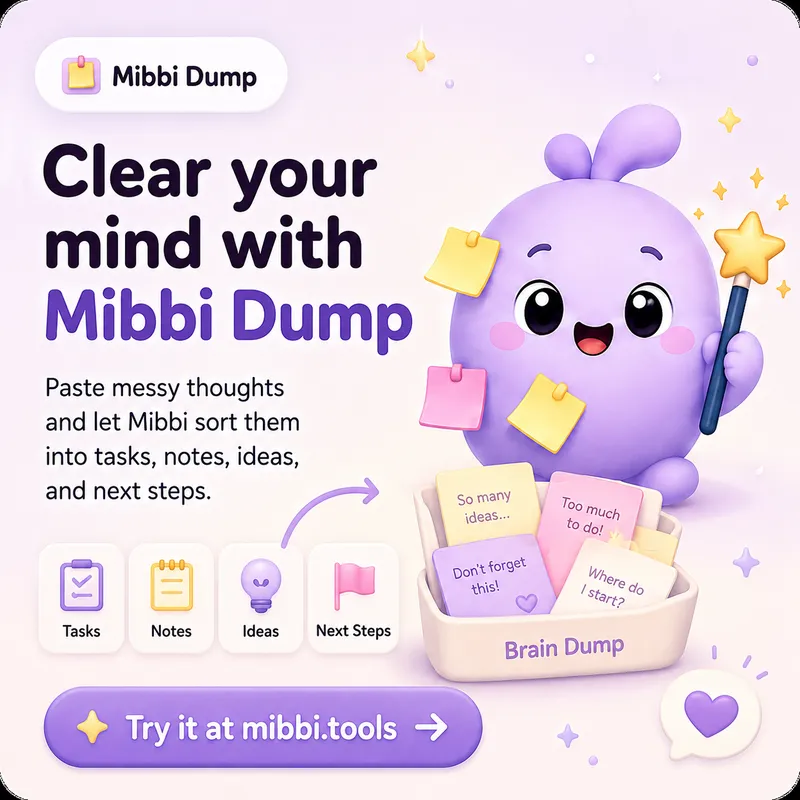
How to Turn a Brain Dump Into a Task List
A method for taking the messy paragraph in your head and turning it into a list of tasks, questions, and reminders you can act on.
-
How to Organize Messy Notes Without a Weekend
Turn a folder of scattered notes into something you can actually use — a low-effort weekly method that gets most of the value without a weekend of tidying.
-
How to Turn Worries Into Action Steps
A practical method for converting the swirling worries in your head into things you can actually do something about.
-
How to Use Brain Dumps For Productivity
How and when to do a brain dump so it actually helps you get things done — not just a wall of text you never read again. Capture, sort, act, repeat weekly.
-
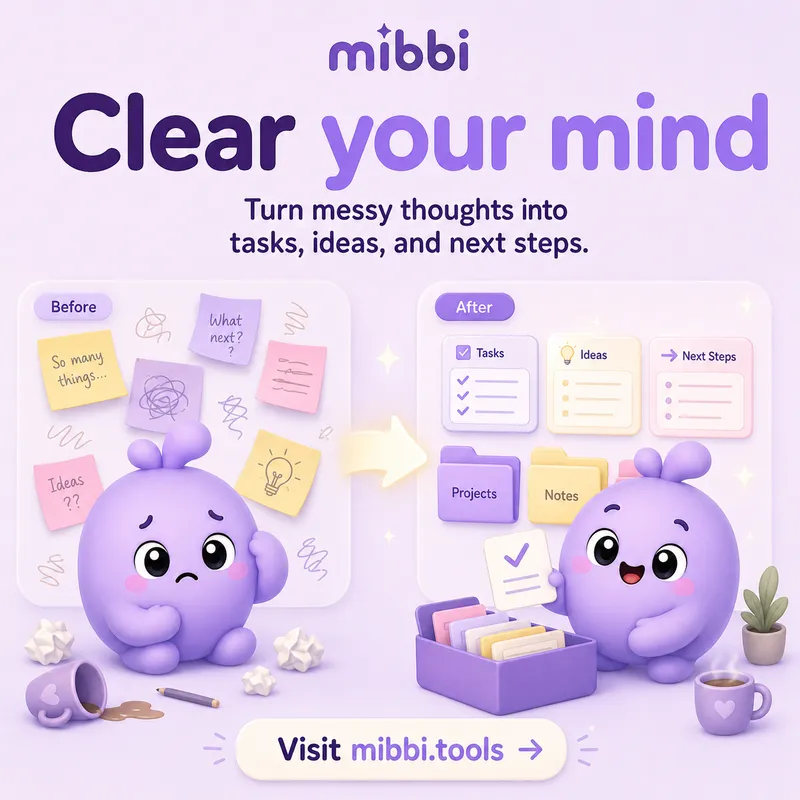
How to Clear Your Mind After a Stressful Day
A simple 10-minute method for getting the day out of your head — so you can actually rest, sleep, or just be present in the evening.
-
How to Process Meeting Notes Into Actions
Most meeting notes turn into nothing. Here is the 5-minute method that turns them into actions, decisions, and follow-ups.
-
How to Organize Your Thoughts Before a Conversation
Important conversations go better when your thoughts are sorted in advance. Here is a 10-minute pre-conversation method.
-
How to Do a Weekly Brain Dump
A weekly brain dump catches the slow-building thoughts daily journaling misses. Here is how to structure one in about 15 minutes.
-
The ADHD Brain Dump Method: Turn the Mess in Your Head Into a To-Do List in 60 Seconds
A fast brain dump method for ADHD: get every loose thought out of your head, then turn the pile into a clear, doable to-do list without overthinking.
-
Best AI Brain Dump Apps in 2026 (Tested for an ADHD Brain)
The best AI brain dump apps in 2026, compared for ADHD brains — which ones turn a messy stream of thoughts into a real to-do list, and which just store the mess.
Guides for Mibbi Chef
Cook with what you already have.
-

What Can I Cook With Ingredients I Already Have?
A practical method for cooking from what is in your kitchen — including how to think about substitutions and basics.
-
How to Cook With a Nearly Empty Fridge
A short guide to cooking a real meal when there are only three or four ingredients left — no shopping trip and no recipe required.
-
How to Cook When You Are Tired But Need to Eat
Tired-but-hungry is the worst combination. Here is how to feed yourself a real meal without the energy or motivation you simply do not have.
-
How to Plan Meals Around Allergies Safely
Cooking around allergies calls for a different default mindset. Here is a safety-first method for planning meals the whole table can eat.
-
How to Use Up Vegetables Before They Spoil
The vegetable drawer is where good intentions quietly go to die. Here is how to actually use them up before they spoil and end up in the bin.
-
How to Cook a Real Meal in 15 Minutes as a Beginner
Fifteen minutes is enough for a real meal if you pick the right recipe. Here is what beginner-friendly fast cooking looks like.
-
How to Cook a Budget Meal With Pantry Staples
Pantry staples cost less per serving than almost anything in the freezer aisle. Here is how to turn them into meals you will actually want to eat.
-
How to Substitute Ingredients Safely
Ingredient substitutions save a meal when done well and ruin it when done badly. Here is a simple rule of thumb for swapping safely without wrecking dinner.
-
What Can I Cook With What's in My Fridge? An AI Recipe Trick for Low-Spoons Days
Too tired to plan a meal but need to eat? Here is how to cook with whatever is already in your fridge — a low-effort method for low-energy, low-spoons days.