
AI for ADHD: How Mibbi's Tiny Tools Help an ADHD Brain Get Things Done
Most productivity advice assumes the hard part is knowing what to do. For an ADHD brain, the hard part is everything around that: starting, choosing, switching, finishing, and not drowning in your own thoughts on the way. This is a guide to using AI for those specific moments — not as a magic fix, but as a set of tiny helpers for the steps your brain finds expensive.
Why generic productivity apps fail ADHD brains
A typical app hands you an empty list and assumes you will fill it, sort it, and work it in order. Every one of those is an executive-function task — the exact thing ADHD makes harder. So the tool that was meant to help becomes one more thing you are behind on.
The fix is not more features. It is smaller asks. A good AI helper should do the expensive step for you — name the first move, sort the pile, pick the one thing — so your attention goes to doing, not organising.
What "AI for ADHD" should actually do
Three things, mostly: lower the cost of starting, hold the thoughts you cannot keep in your head, and remove decisions you do not need to make. Anything that adds setup, configuration, or a blank box is working against you.
Mibbi is built as nine separate tiny tools rather than one big system, on purpose. You open the one that matches the moment, get an answer, and close it. No dashboard to maintain.
Starting: task paralysis and the blank page
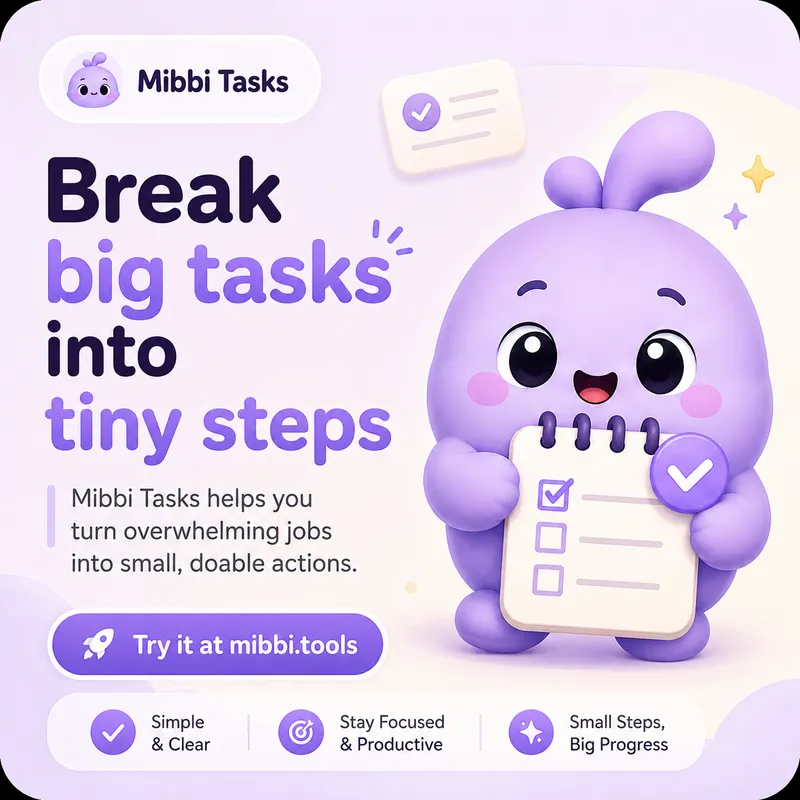
When a task feels too big to begin, the problem is usually that it is not one task — it is twenty hiding behind a label. Mibbi Tasks turns that label into a first tiny step you can take in the next ten minutes, and Mibbi Focus takes a full list and hands back just one next thing when choosing is the barrier.
Capturing: the thoughts that will not stop looping
ADHD working memory is small and leaky, so unfinished thoughts loop to avoid being forgotten. That looping is the background noise. Mibbi Dump lets you empty everything out in one messy go, then sorts the pile into something you can act on — capture first, organise second.
Deciding, communicating, and time
When every option feels equally weighted, Mibbi Decide lays out the trade-offs and a low-regret next step. When you cannot tell how a message will land, Mibbi Tone reads it for you and Mibbi Writer rewrites it without flattening your voice. And when "five minutes" really means forty, Mibbi Estimate gives an honest range so you stop overcommitting.
None of these replace your judgement. They remove the friction in front of it.
One brain, nine small helpers
You do not need all nine. Pick the one that matches where you keep getting stuck and start there. The point is not to build a system you have to keep up with — it is to have a small, calm helper on hand for the exact step your brain finds hardest, the moment you need it.
Try it with Mibbi Tasks
Break big tasks into tiny steps.
Open Mibbi TasksFAQ
- Is AI actually good for ADHD?
- It can be, when it does the executive-function step for you instead of adding one. Tools that break a task down, sort a brain dump, or pick the next thing remove the part ADHD struggles with most. Tools that need setup and upkeep tend to become one more thing to fall behind on.
- Which Mibbi tool should I start with?
- Start with the moment you get stuck most. If you freeze at the start, use Tasks or Focus. If your head is too full, use Dump. If sending messages causes dread, use Tone or Writer. You can ignore the rest until you need them.
Related guides
- How to Break Big Tasks Into Small Steps A practical method to break a task that feels too big into small, doable steps — without writing a 40-line plan first.
- How to Make Your To-Do List Less Overwhelming Five small changes that turn a panic-inducing to-do list into one you actually open every day — cap it, split it, rewrite it, estimate it, and review it.
- How to Break Down a Work Project Into Doable Steps A practical method for turning a vague project brief into a working plan you can start today — without writing a thirty-page proposal first.