
How to Decide Between Two Job Offers
Job offer decisions are big, slow to reverse, and full of false precision. The numbers tempt you into a spreadsheet, then the spreadsheet stalls you. Here is how to compare two offers honestly and decide without overthinking it.
List the five things that actually matter
Salary, role, manager, growth, lifestyle — pick the five factors, not ten, that will drive your day-to-day satisfaction. A longer list feels thorough but mostly adds noise that hides the real trade-off.
Write the five down before you look at either offer. Naming what you care about first stops the better-marketed offer from quietly setting your criteria for you.
Rate honestly, not aspirationally
Rate each offer on what is true today, not what you hope becomes true. "They said there's room to grow" is a wish; "the last three people in this role were promoted" is a fact.
Hope is not a comparison axis. If you would not bet money on it, do not score it as if it has already happened.
Talk to one person at each company
Not the recruiter — a peer who actually does the role. Ten honest minutes with each will surface more than a week of refreshing Glassdoor.
Ask concrete questions: what does a bad week look like, how is the manager when things go wrong, would they take the job again. Specifics travel; vibes do not.
Trust the gut as a tiebreaker
If the analysis lands flat and the two offers look genuinely similar, your gut feeling is a fair tiebreaker. It often encodes signals you noticed but cannot articulate yet.
Use it last, not first. The gut is a great deciding vote and a terrible sole judge — let the criteria do the heavy lifting, then let instinct break the tie.
Lay both offers against what you care about
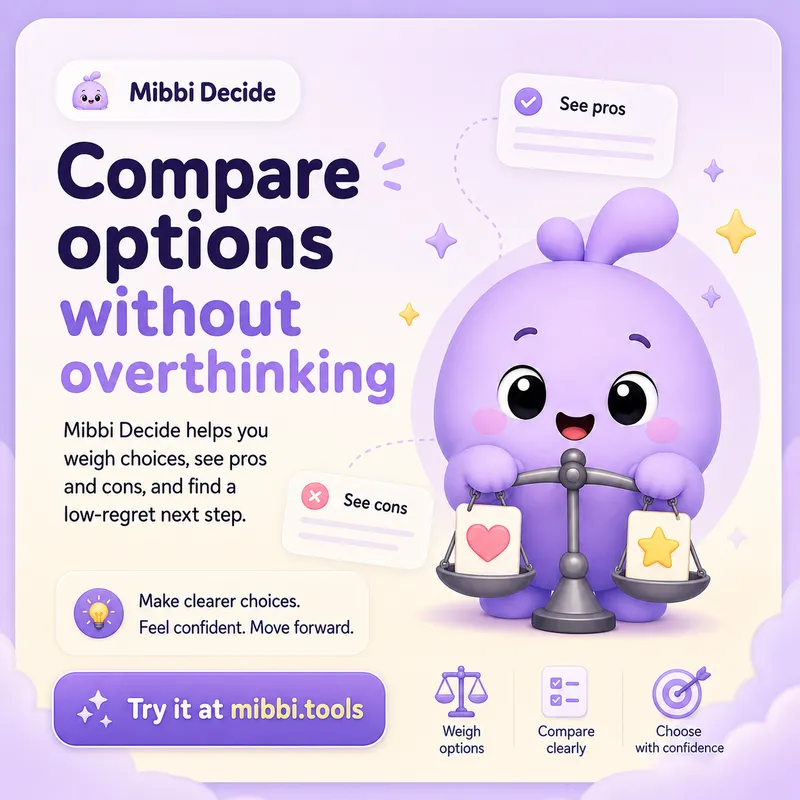
Once you have your five factors and your honest ratings, the decision is mostly about seeing them side by side. Mibbi Decide takes your two offers and the things you care about and lays them out together, so the stronger fit becomes visible instead of hypothetical.
You stay in charge of the call — the tool just makes the trade-offs you already sensed impossible to ignore. When one offer clearly wins on the factors you ranked highest, the spreadsheet paralysis quietly disappears.
Try it with Mibbi Decide
Compare options without overthinking.
Open Mibbi DecideFAQ
- Should I negotiate before deciding?
- Yes — usually. Negotiation often changes which offer is actually better, and a reasonable ask rarely makes a company withdraw. Decide what you would accept first, then negotiate toward it.
- What if I get a pros and cons list and they tie?
- A tie usually means you have not weighted the factors yet — cost and manager rarely matter equally. Re-rank by your top one or two criteria, and if it is still even, pick the more reversible offer.
Related guides
- How to Make a Decision With Pros and Cons Pros and cons lists fail when they get long. Here is a tighter way to compare options that ends with a low-regret next step.
- How to Avoid Overthinking Simple Decisions A short guide to making small choices fast — without saving your decision energy for the things that actually matter.
- How to Decide When the Options Feel Identical Some decisions stall because all paths look equal. Here is what to do when the options refuse to differentiate themselves.