
Executive Dysfunction Explained — and the Tools That Actually Help You Start
Executive dysfunction is the maddening gap between intention and action — you know the task, you want it done, and your brain still will not initiate it. It is common in ADHD, autism, depression, and plain burnout. Understanding it is the first step to working with it instead of fighting yourself.
What "executive function" actually means
Executive functions are the mental skills that get things done: starting tasks, planning, switching focus, holding steps in mind, and managing time.
When they misfire — executive dysfunction — the bottleneck is usually starting and sequencing, not ability or desire.
Why "just try harder" backfires
Effort cannot fix a wiring problem. Pushing harder adds shame, and shame makes initiation even harder. The way through is to lower the barrier, not raise the pressure.
Externalise the steps
Hold nothing in your head. Get the task and its steps onto a screen or page, so your brain spends energy doing instead of remembering.
Make starting the only decision
Reduce the task to one tiny, physical first step and ignore the rest. The hardest moment is the start; everything else is easier once you are moving.
Tools that act as external executive function
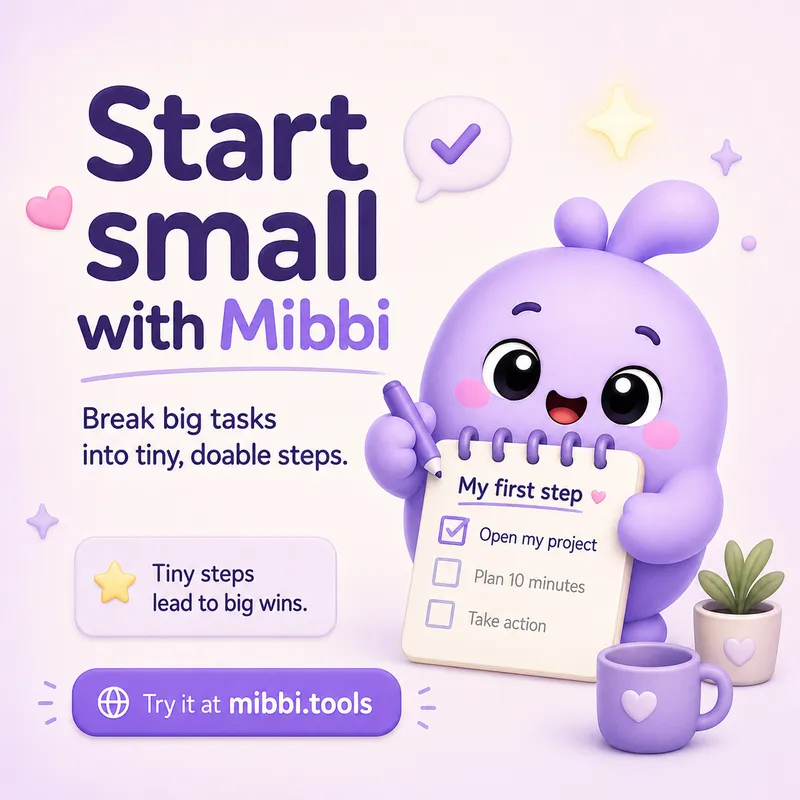
Mibbi Tasks breaks the job into steps, and Mibbi Focus picks the one to start — together they do the planning and initiating your executive function struggles with, so you can just begin.
Try it with Mibbi Tasks
Break big tasks into tiny steps.
Open Mibbi TasksFAQ
- Is executive dysfunction the same as laziness?
- No. Laziness implies not caring. Executive dysfunction is wanting to act and being unable to start — the distress people feel about it is the clearest sign it is not laziness.
- Can you improve executive function?
- You can support it with external structure, routines, and tools, and treatment helps many people. But the most reliable wins come from offloading the hard parts, not willing them away.
Related guides
- How to Break Big Tasks Into Small Steps A practical method to break a task that feels too big into small, doable steps — without writing a 40-line plan first.
- How to Make Your To-Do List Less Overwhelming Five small changes that turn a panic-inducing to-do list into one you actually open every day — cap it, split it, rewrite it, estimate it, and review it.
- How to Break Down a Work Project Into Doable Steps A practical method for turning a vague project brief into a working plan you can start today — without writing a thirty-page proposal first.